Showing posts with label EUCHARIST. Show all posts

Saturday, November 3, 2012

WONDERFUL TRUTH - JESUS ALIVE and PRESENT in the Holy Eucharist

Testimony of Fr Paresh Parmar given at First Friday Gathering - Tabor Ashram

Fr. Paresh Parmar, Gujarat (Ahmedabad diocese)

Brief Background

I am a Gujarati, from Bombay. Though my forefathers hail from Gujarat, we have settled down in Bombay since last two generations. We converted to Catholicism since the last two generations only, as the church of Gujarat is 114 years old..
I was born and brought up in Bombay. My daddy expired when I was in 9th std. Being the youngest of six brothers and sisters, I was showered with a lot of love and care. 


Fr Paresh Parmar - center


I joined the Engineering College (Production Engineering) soon after my 12th std. I was elected as the General Secretary of the college. I was into blood donations and was also involved in other social work in hospitals and other public centers. When once I visited TATA hospital I met a little 11yr old girl suffering from leukemia. Her parents were finding it difficult to get blood donors for her. In Bombay there are several such families begging to the doctors for the life of their babies. 

************

Paresh experiences the fact of earthly life - Death is inevitable
I decided to help this little girl. We had a big group of blood donors. I also arranged for the treatment expense. Though we tried our best to save her life she died in 6 months. This death had its effect on me and my perspective about life changed. My dream was to become successful person, go abroad and work but suddenly, I saw that nothing or no one can stop prevent death, no matter how much money you have!
Desire gets Deeper to know God

I started asking God 'why do you allow so much suffering? Why do you allow people to cry?' I wanted to experience God if He really existed and my search for God began.
 
I was just a routine church- goer. During those days I got my hand on a philosophical book by Swami Vivekananda. I found it interesting. I read all the volumes of the books by Swami Vivekananda. Somehow I felt that we can never encounter God at home. One needs to renounce the world. Thus, with little or no faith in Jesus, I went to Gujarat to become a priest. I spent a year there but I was not happy. I left the place and retuned back to Bombay.
 
*********

Initial seminary life is dry and deserted - no God felt
Even though I tried to become a priest I couldn't experience God. As soon as I left the seminary my brothers and sisters-in-law wanted me to get married. I was not ready for marriage and so finally I reached a decision to open a factory in Bombay. However even this did not give me any satisfaction instead my desire to experience God grew stronger. Not knowing what to do I started visiting famous Swamis and Gurus all over India. I visited many Ashrams. I met preachers of different communities. 


Paresh stops going to Church, visits Hindu temples
Every Monday I used to go to Shiv Temple, Tuesday - Friday I went to Kali and Durga devi temple and Saturdays to Hanuman temple. I used to get up at 3:30 a.m , have a cold water dip, do kriya yoga etc. although I was a catholic I completely stopped going to Church. Some of India's famous Swamis used to come to my house and take me with them to their ashrams.I used to go with them to the jungles and stay for 10-15 days with them.
 
********* 

Attains Psychic powers through Yoga
Because of my yoga practices, I started getting some psychic gifts But my Hindu guru's kept telling me that if I get stuck with the spiritual gifts, then I will not be able to experience the 'giver of the gifts, i.e. God. So I continued in my search for God. I was looking for a Guru who would accept me as his disciple. A well known Hath-Yogi from Malad, Bombay had told me several times that Jesus is my Guru and that I have to become a priest. My mom began to get worried about me seeing me running after so many gurus.

 
Mantra from the Hindu Guru - but emptiness still felt

A 108 year old guru from a village called Zarap, near Sawantwadi [Maharashtra], gave me a guru mantra (a chant) and asked me to recite and see its power. I started reciting the mantra. I was very happy and recited that mantra religiously. I had already spent two and a half years since I had left my seminary and seeking God following the Hindu guru's. Nothing seemed to be happening. Infact I was experiencing some sort of turmoil within me.

 
Fr Paresh Parmar

********* 

Attends a Catholic parish prayer meeting

On 7th of June, 1994 I was out for an evening walk and was passing through my parish church (St. Teresa's Church) in Bandra (Mumbai, India). I saw the board 'Jesus heals'. A force dragged me into the Church. I was not aware of the charismatic movement at that time. When I entered I noticed that Fr. Joe Santiago from Poona Diocese was conducting the prayer services. People were screaming on the top of their voices shouting 'Alleluia' before the exposed Blessed Sacrament. I found all this a bit funny. I found myself misplaced there and was just waiting for this prayer service to get over so that I could get out of all that madness.
 

Jesus Reveals Himself to Paresh Parmar from the Blessed Scarament of the Holy Eucharist

At 9 pm, the priest asked all of us to stand up and pray so that the Lord may touch us. I too got up casually looking all around with curiosity. And lo... what happens....Suddenly I saw a ball of light on the altar. The light entered into my heart and I fell down. I was embraced and engulfed with that light. I instantly recognized the light. HE WAS JESUS

Jesus was right in front of me. I could hear His voice saying "I am the Master you are looking for. I have a plan for you to become a priest; go to Gujarat and I have a plan for you there". I could experience the light for 10 minutes. I could experience a power entering my body and another power leaving my body. I was getting transformed. Like 'Saul was becoming Paul'. 

********* 

JESUS gives Paresh the gifts of tongues and healing
 
After the prayers I found myself a changed person. I came home and for the first time in my life I started reading Bible with devotion. I miraculously came in touch with my college friend Ralph, who was into healing ministry. I joined his prayer group and there I received the gift of tongues and the gift of healing.
 

Paresh joins seminary and is ordained a Catholic Priest - as commanded by the Lord Jesus
Having confirmed Gods call, I left my home once again to join priesthood. I went to Gujarat and met the Bishop of Ahmedabad and he accepted me in his diocese. I was 28 years old when I joined. And today, I am 40, and have completed 4...years of my priesthood and I continue to serve our LORD in His vineyard. Praise the Lord. Many are the wonders he has worked in my life thereafter and continues to work everyday of my life. Today I am convinced beyond any doubt that our Lord is the true God and also the only living God. Thank you Jesus Praise you Jesus.


Seeking stops at Lord Jesus Christ - The Way, The Truth, The Life

I would like to conclude my testimony by stating that if any of you are searching for the one true living God then it stops at Jesus. I have been through the arduous path and convinced myself beyond any doubt.
  
**********

"As a man must be born before he can begin to lead his physical life, so he must be born to lead a Divine Life. That birth occurs in the Sacrament of Baptism. To survive, he must be nourished by Divine Life; that is done in the Sacrament of the Holy Eucharist."
- Archbishop Fulton J. Sheen

Tuesday, March 15, 2011

Divine Retreat Ministry - the powerful healing and loving presence of Jesus Christ

The Holy Father Pope John Paul II has given the urgent call for New Evangelization in the Church. "I see the dawning of a New Missionary Age. The urgency of the New Evangelization demands that the Religious today…stay in the very vanguard of preaching." Inspired by the Holy Spirit, the Chapter of the Mary Martha Province of the Vincentian Congregation in India decided that the Potta-Divine Retreat ministry, India, would be the response of the Vincentian Congregation to this call of the Pope.

Why you must attend a good retreat?
1) In the retreat,
the people are led to a total self-surrender, that results in an intimate union with Jesus in the Holy Spirit, as experienced in the Sacrament of the Holy Eucharist

2) After you totally surrender, without any slightest doubt, then, through the experience of the Sacrament of Confession, the retreatants are 

  • convicted of their sin by the Holy Spirit (Jn 16:8),
  • forgiven of their sin by the Holy Spirit (Jn 16:8),
  • forgiven of their sins in the power of the same Holy Spirit through the ministry of the Church (Jn 20:22-23), and
  • given a share in the victory of Jesus over sin (Jn 16:11)


Does Jesus really enter into your life ?
Yes, Jesus is Alive and Active. Jesus is so great that he has time for each and every one of you.


******Jesus has promised******

"He who eats my flesh and drinks my blood abides in me, and I in him" (Jn 6:56). In this intimacy, the love of God is "poured into their hearts through the Holy Spirit" (Rom 5:5). The heart melting under this overwhelming outpouring of love, opens up in turn to love and forgive everyone


For current retreat schedules


POWER 2011 in Divine, (July 24th - 29th)

DRC is back with the highlight of the year: The 6th International Youth Conference - POWER 2011. The very best of International preachers and Gospel bands will be here in Divine to lead us into an awesome experience with the Lord. Be there to experience a totally different atmosphere of prayer. There will be a Couples Retreat and Children's Retreat as well held simultaneously. Don't miss it!

Date: July 24th - July 29th, 2011

******
 
Retreats in the USA (April 1st - April 10th)

The Divine team led by Fr. Augustine Vallooran VC will be conducting retreats in Dallas (http://www.dallasdivineretreat.us/Content/Welcome.html), Los Angeles and Virginia (www.divinemercyva.org), USA from the 1st of April to the 10th of April, 2011. Be there and experience the love and mercy of our Lord.

******
Retreats in Canada, (March 8th - 20th)

Jesus calls you to experience His love and mercy. Fr. Michael Payyapilly VC and Fr. Joby Kachappilly VC will be conducting retreats in Canada in the month of March. They will be joined by the singing couple of Divine - Glen and Teresa La'Rive.

******

Preaching risen Christ to our Muslim brothers and sisters
Retreats in the UAE, (March 18th - March 31st)

Fr. Augustine Vallooran VC will be conducting retreats in the emirates of Abu Dhabi and Sharjah from the 18th of March till the 31st of March, 2011. Come and experience the powerful presence of Jesus during these retreats.


******

This intense experience of love heals all wounds and soothes all the strains in family relationships. The bond of marriage is renewed as a Sacrament of grace incorporated into the spousal relationship between Christ and the Church.


******
 
The Charism of healing is exercised in the context of the Sacrament of the Anointing of the Sick. Healing is understood not in the narrow sense of bodily well-being, but as the love of God flowing into all the brokenness of man to make him whole. The leadership given by the priests in preaching and the exercise of the Sacraments manifests the importance of the Sacrament of Holy Orders. All the charisms of the lay leaders such as counselling, preaching, service and so on, are harmoniously blended and channelized through the Sacramental authority of the priests.


******

The retreat ends with the renewal of the Sacramental vows of Baptism and a fresh anointing of the Holy Spirit as experienced in the Sacrament of Confirmation. This all-transforming experience of the baptism of the Holy Spirit is the fulfilment of the promise of Jesus. "But you shall receive power when the Holy Spirit has come upon you; and you shall be my witnesses…to the ends of the earth"(Acts 1:8). This empowering of the Holy Spirit is accepted as a special grace to withstand the temptations of the evil one and to defend and spread the faith by word and action confessing Jesus Christ as the only Saviour of Mankind.


******

The grace of these seven Sacraments instituted by Christ as signs of salvation and entrusted to the Church, is experienced afresh in the action of the Holy Spirit for the renewal of Christian commitment.

Thursday, September 16, 2010

Catholic Church where people of all faiths seek divine power over diseases and evil

Fr Anthony Parankimalil V.C, who leads worship at the Vincentian Prayer House in Nairobi. Photo/ANTHONY NJOROGE


By MWAURA NDUNG’U
Saturday, June 5 2010

On a Saturday afternoon, under a mabati canopy in a compound on Amboseli Road in Lavington, Nairobi, masses of people gather to sing and dance in a manner so exuberant one might think pentacostal worship is underway.
But the beaming ushers holding rosaries and the display of catechisms for sale hint at the Roman Catholic church.

Welcome to the Vincentian Prayer House where Catholics, Protestants, Hindus, Muslims and even atheists gather to seek divine intervention on various problems in their lives or to quench their spiritual thirst under the guidance of Catholic priests from India.
As the singing dies down, a priest in a white robe proclaims loudly that Jesus is aware of all sicknesses, sorrows and pains and, as the Bible says in Jeremiah 33:3, is available to answer all calls. Tears of joy flow from the eyes of those who believe their illnesses will be healed as others break into dance.
Monthly retreats
The Vincentian Fathers attract many people to their monthly retreats and daily prayer services.
Father Anthony Parankimalil VC, the director of the Vincentian Prayer House in Nairobi, says theirs is an evangelisation ministry which welcomes all people irrespective of their religion, caste, tribe or faith.
Are they part of the charismatic movement?
“We welcome even the atheists to know the love of God, and we minister through the inspiration of the Holy Spirit whereas the charismatic movement is for renewal within the Catholic Church.”

Nairobi’s Vincentian Prayer House belongs to the Vincentian Congregation which was founded in Kerala, India, on November 20, 1904 by Fr Varkey Kattatath.
It is based on the Common Rules of St Vincent de Paul, who is commonly known as the father of the poor because he preached to them in accordance with Luke 4:18 in which Jesus proclaimed: “The spirit of the Lord is upon me. He has anointed me to preach the good news to the poor.”

According to Fr Anthony, the congregation has spread all over India and abroad to 15 countries including Kenya, Uganda and Tanzania. There are 430 Vincentian priests.
In Kenya, the congregation is under the Archdiocese of Nairobi. Their prayer house was built in 2001 on the edge of Kawangware.
Grow in faith
Fr Anthony said their mission has two dimensions: to preach to the non-Christians so that they may be brought to the Christian faith and to Christians to help them grow in faith.
The Very Rev Fr Vincent Rathappillil VC is the regional superior of the Vincentian Fathers in East Africa. He is also the superior of the Vincentian Prayer House. The administrator of the prayer house, Fr Raphael Karalathukaran VC, is also actively involved in the ministry.
The prayer house has more than 200 members.

Father Joshy Kochukudiattil VC, the director of Tabor Retreat Centre in Mumbai, who visited Nairobi recently, said their congregation should not be thought to have broken with the traditional Catholic way of praying.

Scripture readings
Within the fixed structure of the Roman Catholic church, the Mass takes a common path: The scripture readings, the antiphons sung or recited during the entrance procession or communion, and the texts of the three prayers known as the collect, the prayer over the gifts, and the post-communion prayer (they vary each day according to the liturgical
season), the feast days of titles or events in the life of Christ, the feast days and commemorations of the saints, or for Masses for particular circumstances.

But the Vincentian Fathers say that there is much more that is not commonly practised.
“The Catholic church has a very rich tradition beyond what we may have seen. Eucharistic prayer is the centre of the Catholic faith, but it also has charismatic, meditative, liturgical, devotional and vocal prayers.
“Jesus, being a person with many different charisms (gifts of grace), the Catholic church also has many different congregations and organisations with very different charisms. We are not able to follow all of them, but only one means used by the Lord, that is, evangelisation.”

Fr. Joshy pointed out that the Vincentian Fathers follow the specific instruction of Christ as written in Matthew 28:19-20: “Go therefore and make disciples of all nations, baptising them in the name of the Father, the Son and the Holy spirit, teaching them to obey everything that I’ve commanded you.”

He said in India, a predominantly Hindu country with a Muslim minority, about 4,000 non-Christians in Mumbai attend services at the Tabor Retreat Centre designed especially for them.
At the centre in Nairobi, people come from all over Kenya to attend the prayer services held every day but Sunday to give the priests a break and to allow people to attend services at their churches.
But Saturday is the main day when throngs converge on the compound for the Eucharistic adoration.
A priest leads the congregation in prayer, calling on them to repent their sins and forgive their enemies unconditionally.
After the prayer session, those who believe they have been “touched” by the Lord join the long queue to the pulpit to testify. Only a few get the chance, but they are cheered and applauded.
Why do some people say they have been healed of their illnesses while others go home without their miracle?

“It is the Lord who chooses whom to heal and when,” Fr Anthony says. “Those who come in full faith and have forgiven their enemies can expect the intervention of the Lord, and they have to receive the inner healing before they open themselves up for spiritual and physical healing.”
But many congregants still line up to seek the priest’s personal intervention, and he gives them a prescription from the Holy Scriptures.
Although the Vincentian Fathers do not advertise, their monthly retreats at their prayer house and the University of Nairobi are always full houses.
And now, for the first time, the congregation will hold a Bible convention at Nairobi’s Uhuru Park from July 21 to July 25 conducted by the two priests and the Rt Rev David Kamau, the auxiliary bishop of the Roman Catholic Diocese of Nairobi.
Hundreds of believers have posted testimonies at www.vphnairobi.org, the congregation’s web site.

Living proof
Pamela Mandela, a human anatomy lecturer at the University of Nairobi’s Chiromo campus, says she is living proof that everything is possible before God.
Dr Mandela says she suffered an attack of TB-meningitis last October which not only threatened her career but also her life. Her condition deteriorated after admission at the MP Shah Hospital.
“It was in January this year when I had lost all hope of living another day that a relative introduced me to Fr Anthony,” she says.
“At first I was hesitant, but my desperation pushed me to grab the opportunity,” says the don who also teaches doctors.
“The priest gave me some scriptures from the Holy Bible to read for a whole month, which I obediently did.
Immediately I finished the homework, I attended a five-day retreat at the centre, and Fr Anthony asked those experiencing body weaknesses to stand up. I did not because I was very weak, but he prayed for all of us.”
The following morning, she said, she suddenly gain “miraculous strength” and stood without support.
“I jumped up and down happily, and my relatives could not believe what had happened to me. My doctor could also not believe when I excitedly broke the news to him that I had fully recovered,” she said.
“I had to call my colleagues at the university who had planned to visit me on my death bed that very day. They were amazed to find me in the condition I was before the attack. It is a big miracle that God has given me another chance to live.”
For Agrippine Baraho, a Rwandan refugee, who is a single mother of 14-year-old twin daughters, there is no disease that is incurable to God.

“When I visited Vincentian Prayer House in 2007, I was in my final stage of HIV/Aids. My mission was to ask the priest to pray for my young daughters to get a responsible guardian as I was about to leave them for another world.”
She said she was sceptical at first when the priest asked whether she believed Jesus could heal her.
“He gave me some scriptures to read for a month and also asked me to be attending the Holy Mass every day and ensure I received the Holy Eucharist for a month. I am now well and weigh 73kg,” she said.
Peter Idenya, a widower and father whose two daughters are doctors says he suffered excruciating back pain for five years without a medical solution.
Changed my life
“Funny enough, my doctor advised me to try out prayers for healing and offered herself to bring me to the prayer house,” he said. “I had almost given up when, after attending the service two times without any improvement, my third day there changed my life entirely.”
“As Fr Anthony continued praying for the sick, I felt a strong wave akin to electric shock running from my head to my toes as I sat in my wheelchair. People were praying and loudly calling out to Jesus.

“The priest then asked people to kneel down, and I found myself on my knees which I had not been able to do since I became sick. Everyone, including me, was amazed by the turn of events. I kept jumping around singing for the Lord long after others had taken their seats.

“I am a living testimony there is healing power in the living God as now I am totally healed, and the pain is long gone,” he said.
Another congregant at the Vincentian Prayer House is Catherine Kuria, a career public servant who serves as a director of the Kenya Airports Authority board. She is a Roman Catholic and her daughter had abandoned her faith.
“I kept praying for her to come back to the faith she had been brought up in. After long prayers and attending last month’s Lenten retreat at the Vincentian Prayer House, she told me she had decided to return to her mother church.”

Thursday, February 25, 2010

THE EUCHARIST AS SACRIFICE

THE EUCHARIST AS SACRIFICE 
- THE SOURCE AND SUMMIT OF THE CHURCH IN INDIA

by Fr. Bryan Lobo, S.J.


(Fr Bryan Lobo s.j with Pope Benedict XVI)

INTRODUCTION
I am writing this paper as an Indian Catholic Theologian. I shall therefore present the convictions and beliefs of the Catholic Church on the Eucharist, in the light of the Synod of Bishops that was recently held on the Eucharist and which was called, “THE EUCHARIST: SOURCE AND SUMMIT OF THE LIFE AND MISSION OF THE CHURCH”, bearing in mind my Indianness. Among the many important themes emerging from the Instrumentum Laboris[1] and from the 50 Propositions[2], I have chosen SACRIFICE as the Eucharistic theme for my paper. This theme I find extremely important for the Indian Church because of its intimate connection to the Indian religious psyche[3].

THE EUCHARIST AS SACRIFICE
The OT is replete with instances of sacrifices offered to God. Animals, birds and crops were offered to God for various intentions; for worship (Gen 4: 2-5), for atonement of sin (Heb 9:22), to seal a covenant (Exod 24: 4-8) and to strengthen the bond between God and the devotees. In this way sacrifice became a means to relate to God for personal and communitarian salvation[4]. 

There were also moments in the life of the Israelite community when animal sacrifices became abominable to God especially when offered by devotees who never bothered to do the will of God in their personal and social lives and took the cover of sacrifices to appease God and assure salvation for themselves. This attitude led to cultic ritualism which was heavily criticised by prophets especially Isaiah, Hosea and Amos (Isa 1:2-31; Hos 6:6; Amos 5:21-24). Outward sacrifices could therefore not be an excuse for inner disobedience. Sacrifices to God had to be pure in both ways interior and exterior. Only then would it be pleasing to God and assure one the salvation that one sought. 

The sacrifice of Jesus was seen as transcending the sacrifices of the OT. In the OT the sacrifices were repeated but the sacrifice of Jesus was once and for all (Heb 10:1-10). The OT sacrifices were animal sacrifices but the sacrifice of Jesus was of himself; a self-offering. The benefit of the OT sacrifices also included the priest but the sacrifice of Jesus benefited him in no way; it was for the salvation of others. The salvific motif is later seen by the Apostles as the underlying motif of Jesus’ death. 

What makes the Apostles see this motif in the death of Jesus? 
It was the Last Supper. At the Last Supper Jesus celebrates the Passover meal with his disciples, giving his own interpretation of that meal. Jesus was placing himself as the Passover lamb who had to be sacrificed for the salvation of all[5]. In 1Cor 5: 6-7, Paul alludes to the Passover feast calling Christ the Paschal lamb that was sacrificed. Jesus understands this sacrifice not only as a one way process from God to humans but also vice versa because he makes us participate in that sacrifice by asking his Apostles (and the future Church that would come into existence), to eat the bread and drink the wine as though they were his body and blood (Mk 14: 22-25; Mt 26: 26-29; Lk 22: 14-23; 1Cor 11: 23-26). 

In this way Jesus makes the future Church (the people of the new Covenant), participate in his sacrifice of redemption. It is this participation that brings salvation and wholeness to the participants. This motif of sacrifice became central to the Eucharist especially during the times of the persecutions of the early Christians. The self-sacrifice of Martyrs, right from the first Pope, Peter, down through the centuries, was and is venerated by a kiss of the altar (the centre of which is supposed to contain the remains of the Martyrs), by the main Celebrant (and Concelebrants) of the Eucharist. The Fathers of the Church, living in varied contexts, gave different perspectives to this sacrificial motif of the mass. 

We know the famous words of St. Ignatius of Antioch (? – 107 AD), “I am the wheat of God, when I am ground may I be found pure bread”(Rom 4).[6] Eusebio of Caesarea (365 – 440 AD) calls the Eucharist the fulfilment of the past prophecies, as a sacrifice offered in a new way according to the law of the New Covenant (Dem. Ev. I. 10).[7] Gregory I (540 – 640 AD) Pope and Doctor of the Church gave a lot of importance to the Eucharist as sacrifice. The sacrificial vocabulary – sacrificium, oblatio, immolatio, victima, hostia, etc were words extensively used by him. 

According to him the passion of Christ is mystically imitated in the Eucharist because the sacrifice of Christ is made present at every Eucharist celebrated by the Priest (Dialogue IV, 58: PL 77, 425).[8] We could go on giving examples on how the Fathers of Church laid prime importance on the sacrificial aspect of the Eucharist but for the lack of time we have to move on. After Martin Luther’s (1483 – 1546) attack on the sacrificial aspect of the Eucharist,[9] many other Catholic theologians like Thomas Cranmer (1486-1556), Robert Bellarmino (1542-1621), and others wrote in defence of the sacrifice of the Eucharist[10]. The Council of Trent (1545) finally upheld the mass as making present the sacrifice of the Cross. It said, “It is one and the same victim here offering himself by the ministry of his priests, who then offered himself on the Cross; it is only the manner of offering that is different” (DS 1743)[11] 

The Second Vatican Ecumenical Council (1962-1965), which opened the doors of the Church to a great renewal, did not allow this sacrificial aspect to loose its significance in the Eucharist. It says, “… our Saviour instituted the Eucharistic Sacrifice of his body and blood … in order to perpetuate the sacrifice of the Cross throughout the ages, until he should come again” (Sacrosanctum Concilium 47). It also sees the faithful as participating in the Eucharistic sacrifice and along with the divine victim offer themselves to God (Lumen Gentium 11). The Church therefore sees the mass as the inseparable sacrificial memorial in which the sacrifice of the Cross is perpetuated (Catechism of the Catholic Church 1382). 

Keeping this whole tradition in mind, the late Pope John Paul II in his Encyclical Ecclesia de Eucharistia, exhorts his faithful to see the sacrifice of Christ as intrinsically connected to the Eucharist. I would like to quote him in full: “The sacrificial nature of the Eucharistic mystery cannot therefore be understood as something separate, independent of the Cross or only indirectly referring to the sacrifice of Calvary.By virtue of its close relationship to the sacrifice of Golgotha, the Eucharist is a sacrifice in the strict sense, and not only in a general way, as if it were simply a matter of Christ’s offering himself to the faithful as their spiritual food” (12 – 13).By now it has become clear that the sacrificial aspect is the sine qua non of the Church’s understanding of the Eucharist. Without this aspect any conception of the Eucharist would be incomplete. Secondly it is taken for granted that Christ’s sacrifice is a means for the salvation of all. This is what makes the Eucharist a means to salvation for all.

SACRIFICE IN HINDUISM
I had mentioned earlier that sacrifice is intimately connected to the Indian psyche. With all the varied religions and their inner dynamics and conflicts in India, Hinduism plays an important role in shaping the psyche of the Indians. The concept of sacrifice is central to Hinduism. Yajna, Tyaga, Tapas, and Bali are words and concepts intrinsically connected to sacrifice. 

In Hindu Cosmogony creation itself is seen as the self sacrifice of the primordial Person who is God. The primordial Person is Purusha (a word that means also ‘man’). We find this idea in the Purusha-Sukta, one of the latest hymns of the Rigveda.[12] This hymn describes a mysterious ancient sacrifice which led to the division of the primordial Purusha from which emerged the different parts of creation[13]. Here two points have to be noted that Cosmos comes into being through the Anthropos (a;nqrwpoj) namely that man (primordial Man who is also considered as Supreme Being), is responsible for the creation of the universe. Secondly it is His sacrifice that brings the universe into existence.[14] Sacrifice therefore becomes the foundation of life itself. When life gets corrupted and looses its inner harmony or rta, sacrifice is performed called Yajna to bring back the cosmos into harmony. Yajna is the re-presentation[15] of the primordial sacrifice of the Purusha. Sacrifice is therefore intimately connected to Wholeness. If wholeness is possible at the cosmological level then it should be a reality at the personal level too. 

This makes individuals do tapas, tyaga, and other personal sacrifices for personal wholeness. The persons who attain wholeness are called Yogis, sants or saints etc. These saints in turn work for the welfare of the people and the society (lokasamgraha). We therefore see that personal and cosmic wholeness are the obligatory goals of sacrifice in Hinduism[16]. At this point one is struck at the vision of Hinduism in terms of sacrifice which so much coincides to the vision of sacrifice in the Eucharist although the differences cannot be overlooked. What remains to be shown is how the Eucharist as sacrifice differs from the vision of sacrifice in Hinduism, at the same time how it upholds and completes the central desire of that vision, becoming in the process, the source and summit of the Church in India.


THE EUCHARIST AS SACRIFICE: THE SOURCE AND SUMMIT OF THE CHURCH IN INDIA
The Purusha Sukta is a myth. The idea of God sacrificing Himself for Cosmic creation or Cosmic wholeness is not realised for the Hindu (Indian) consciousness in an Historical context. One may be even tempted to think that such realizations can only be imagined or construed by one’s theocentric or theistic convictions and may be historically impossible. Well the impossible has become possible in Jesus Christ. God became man in Jesus to reconcile the whole world to Himself. The body and blood of Jesus, who is God historically and really, sacrificed on the altar of the earth on the specific hill of Calvary, has restored wholeness to the Cosmos. It was Theos (qeo.j) becoming Anthropos (a;nqrwpoj) to be sacrificed for the wholeness of the World. 

The Hindu desire expressed in the Purusha Sukta, becomes an Historical reality in Jesus Christ. It gets completed in Jesus Christ. The sacrifice of Jesus Christ is not seen as the Cause of creation as one finds the sacrifice of the Purusha in the Purusha Sukta but of Second Creation (a term used by many theologians today), of Restoration and Redemption. This sacrifice, although it accomplished the work of redemption once and for all, always remains as an offer to humanity for its own wholeness. The person who accepts this offer and participates in this sacrifice by eating the body and drinking the blood of Christ regains health and is made whole and redeemed. How is the presence of the Catholic Church looked at today in India? The presence of the Catholic Church is looked at as leaven in the bread of India. The Catholic Church is helping India to move unitedly to the goal of Dev Rajya, or as many Hindus call it, the Ram Rajya, which we Catholics call the Kingdom of God.[17] 

The Eucharist is the source and summit of the Kingdom of God because the Kingdom of God is realized in the Paschal mystery of Jesus Christ. The Paschal mystery is relived at the Eucharist. It is made present fully and really at the Eucharist. Cardinal Martini very well states, “The Eucharist is, … the Kingdom which is to come; it is a synthesis and a making-present of the Kingdom, and its goal is to be incarnated in those who are fed with the Eucharistic bread and wine, and who thus enter into Jesus’ own sentiments and actions”[18]. 
The Kingdom of God is that cosmic wholeness which the Hindu consciousness and for that matter the Indian consciousness seeks. 

The Eucharist is that moment where the personal and cosmic wholeness is realized. One has to look at this realization with the eyes of faith. Without the eyes of faith the Eucharist may seem a simple ritual where the bread and wine are seen as just symbols of the body and blood of Jesus Christ. This is one of the greatest temptations of the Church in the Indian context. The Eucharist is seen just as a memorial meal where people of all faiths can participate and the bread and wine are simply given to the people as food of the celebration. Such a reductive comprehension of the Eucharist means that we have not understood the reality of the Eucharist at all. It could also mean that the Church through its pastors has failed in providing the proper catechesis required to approach the Eucharist with awe, wonder and faith. 

In Ecclesia de Eucharistia, Pope John Paul II says, “At times one encounters an extremely reductive understanding of the Eucharistic mystery. Stripped of its sacrificial meaning, it is celebrated as if it were simply a fraternal banquet” (10). The Eucharist is not just a ritual or a banquet, but “the sacrament of the sacrifice of Christ done once and for all on behalf of all of us” (The Lime Document 8).[19] In this way the Eucharist cannot be fully understood. It is a mystery whose meaning can never be comprehended but could be deepened in different times and contexts. Cardinal Martini says that the “Eucharist defies human understanding and defies our ability to completely capture its meaning. Pope John Paul II in his letter Mane nobiscum Domine,[20] says, “We are constantly tempted to reduce the Eucharist to our own dimensions, while in reality it is we who must open ourselves up to the dimensions of the Mystery” (14). In Ecclesia de Eucharastia 10, he says, “The Eucharist is too great a gift to tolerate ambiguity and depreciation”. All this goes to say that anyone approaching the Eucharist would be denigrating it if he does not approach it with faith, wonder, respect and love for Jesus in his heart. 

After the consecration, the gifts of bread and wine become really and fully Jesus’ body and blood. It is this belief and conviction that procures for us the salvation of the sacrifice of Jesus represented in the Eucharist. It is because of this requirement that the sacrament of baptism, the catechesis leading to the first holy communion and confession, are preparations presupposed before receiving God in holy communion. The Eucharist is the microcosm of the Kingdom of God. It contains the Kingdom of God in its womb. The salvation sought by the world is so to speak contained in the Eucharist because the Eucharist ‘re-presents’ the salvific activity of the Paschal Mystery of Jesus Christ. On the other hand since the presence of the Catholic Church in India is to help it reach the Kingdom of God, the Eucharist ipso facto becomes the source and summit of the Church in India. All the social, educational, medical and pastoral work done in India by the Indian Church is not just labour but a great sacrifice done by the religious, clergy, missionaries and the Christian people. 

This is the daily martyrdom of the Church in India the source of which, is the sacrifice of Christ celebrated in the Eucharist. As Johannes Betz says: “Christ’s sacrifice is not to be understood primarily in terms of ritual sacrifice, but in terms of martyrdom; it is a person’s total offering of self”.[21] The source of this is the Eucharist. At the same time the Indian Church is helping India in its growth towards the Kingdom of God which is already present in the sacrifice of the Eucharist. In this way the Eucharist as sacrifice becomes the source and summit of the Church in India.

CONCLUSION
In all the preparatory documents of the Synod of Bishops on the Eucharist, especially in the letter of Pope John Paul II, “Mane nobiscum Domine” and his document “Ecclesia de Eucharastia”, one finds great importance given to the sacrificial aspect of the Eucharist. 

The 10th proposition in the Relatio Post Disceptationem[22] makes it explicit that this sacrificial aspect needs to be deepened and its truth taught with greater emphasis. 

The 37th point of the Instrumentum Laboris,[23] makes it clear, that the Eucharist makes present the sacrifice of the Lord without adding to it or multiplying it. Even in the ‘Message’ given after the Synod we find the desire of the Synod to celebrate the Eucharist as a Holy Sacrifice to “announce the salvation of the World” (7).

[24] Finding this theme as important to the Indian context I tried to show how this aspect of the Eucharist fulfils the desire of the Indian psyche for salvation and wholeness both at the personal and the Cosmic level.

[25] In this way the Eucharist gives meaning and mission to the Indian Church because the presence of the Church in India is to offer salvation, which is symbolised in the Kingdom of God, to the people with whom it comes into contact. In this way the Eucharist becomes the source and summit of the Indian Church.


[1] This document was called the “working document” of the synod fathers.
[2] The 50 propositions was a list of various themes that emerged from the discussions to help the Magisterium prepare the final document which is still to be published.
[3] When I say “Indian”, I primarily mean the Hindu religious psyche.
[4] Here ‘salvation’ must be understood not just in an other-worldly way but also in a this-worldly way of health, happiness and prosperity.
[5] For a systematic, in-depth and scholarly account of this aspect of the Last Supper, see, Joachim Jeremias, The Eucharistic words of Jesus (New York: Charles Scribner’s Sons, 1964), pp. 218-237.
[6] Goffredo Boselli, “Notizie Eucaristiche Antichità”, in Eucharistia: Enciclopedia dell’Eucaristia, sotto la direzione di Maurice Brouard, (Bologna: EDB, 2004), p. 885.
[7] Ibid., p. 886.
[8] Mary Shaefer, “Notizie Eucaristiche Medioevo”, in Brouard, op.cit., p. 891.
[9] Here again due to the lack of time, we cannot go into the nuances of Luther’s argument against the Eucharist as sacrifice.
[10] André Haquin, “Notizie Eucaristiche Epoca Moderna”, in Brouard, op.cit., p.897. Here mention could be made of the books Thomas Cranmer and Roberto Bellarmino wrote against the Reformers. Cranmer wrote a book, In defence of the true and Catholic doctrine of the sacrifice of the Eucharist, cited in, Brouard, op.cit., p. 897. Bellarmino wrote a book, Disputationes de controversies christianae fidei adversus huius temporis haereticos, cited in, Brouard, op.cit., p.897.
[11] Cited in the English translation of the Encyclical Ecclesia de Eucharistia by Pope John Paul II (Pauline Publications, 2003), endnotes no. 16, p. 71. This edition will be used for the future references of the Encyclical. Here I would like to offer the reader the Latin original in full: “Una enim eademque est hostia, idem nunc offerens sacerdotum ministerio, qui se ipsum tunc in crude obtulit, sola offerendi ratione diversa”. (DS 1743).
[12] Arthur A. Macdonnell, A Vedic Reader for Students (Madras: Oxford University Press, 1976), p. 195. In Subhash Anand, Hindu Inspiration for Christian Reflection: Towards a Hindu-Christian Theology (Gujarat: GSP, 2004), p. 3.
[13] Cf., Anand, op.cit., p. 3.
[14] This aspect is very well stated and developed in the book of Anand, op.cit., I am very much indebted to this book for these ideas.
[15] Here the word ‘re-presentation’ should not be understood in a Christian way because the sacrifice of the Purusha was not an historical event.
[16] Due to the lack of time we have not gone in the detailed analysis of the concept of sacrifice in Hinduism.
[17] Although both the concepts of Ram Rajya and the Kingdom of God have many similarities, they are symbols that have emerged in different religious and cultural contexts so differences between them exist.
[18] Carlo Maria Cardinal Martini, from a talk given by Cardinal Martini in Rome on February 24, 2005. Translated by Fr. Murray Watson for Catholic Biblical Association Journal, Ontario Canada. I received this talk by email without mention of its source.
[19] In Ibid.,
[20] John Paul II, “Mane nobiscum Domine”, Apostolic letter to the episcopate, clergy and the faithful for the year of the Eucharist Oct. 2004 – Oct 2005 (Pauline Publication: 2005).
[21] Quoted in, J. Ratzinger (Pope Benedict XVI), “Is the Eucharist a Sacrifice”? Translated by John Drury, Concilium 3/1967, vol. 4, pp. 35-40.
[22] Synodus Episcoporum, XI Coetus Generalis Ordinarius, Eucharistia: Fons et Culmen Vitae et Missionis Ecclesiae, Relatio Post Disceptationem, editiones latina et italica (E Civitate Vaticana, MMV).
[23] Synod of Bishops, XI Ordinary General Assembly, The Eucharist: Source and Summit of the Life and Mission of the Church, Instrumentum Laboris. The English translation is available at the following internet site: http://www.vatican.va/roman_curia/synod/documents/rc_synod_doc_20050707_instrlabor-xi-assembly_en.html.
[24] Synodus Episcorum, XI Coetus Generalis Ordinarius, Eucharistia: Fons et Culmen Vitae et Missionis Ecclesiae, Nuntius, English translation (E Civitate Vaticana, 2005), p. 21.
[25] Here the reader could also refer to the 32nd Proposition which states the cosmological dimension of the Eucharist.

Saturday, December 12, 2009

Eucharistic Miracle At Tabor Bhavan on 27 Aug 2007

Miracle of the Eucharist at a catholic retreat centre
 
For now I have chosen and consecrated this house that my name may be there for ever; my eyes and my heart will be there for all time (2 Chronicles 7:16)


At Tabor Bhavan, Raite Village,  
Thane District, Maharashtra, India.
From 27 August 2007 - 30 August 2007


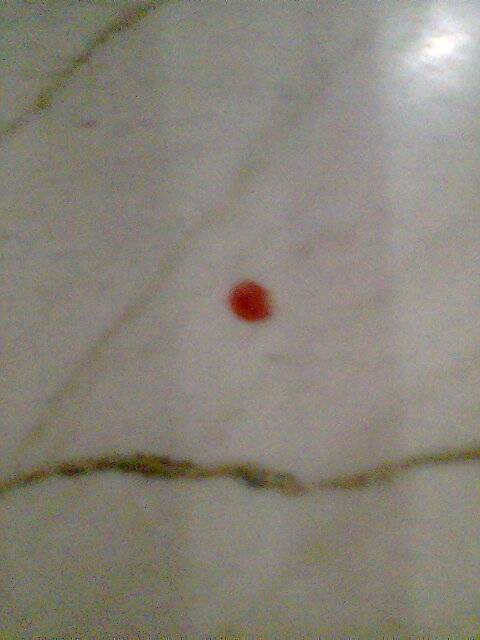
On 27th August 2007 in the presence of around 60 retreatants when Fr Joby was concelebrating Mass along with Fr Anto (a retreatant), during the Epiclesis (that part of the prayer of consecration of the Eucharistic elements (bread and wine) by which the priest invokes the Holy Spirit ) when Fr Joby invoked the the Holy Spirit,  he noticed many drops of water and blood on the altar cloth. He immediately announced to the retreatants that Jesus was pouring out His Blood and Water and continued with the Mass.

Later he testified that the wine to had changed to real Blood and that when had sipped it at communion it smelt like blood and it was not flowing as easily as wine should normally flow. After sipping he found it sticky in his mouth, a sensation which lasted for quite sometime. Fr Anto too testified of a similar experience. (Only the two priests consumed the wine(Blood))
The choir members who were near the altar too witnessed the droplets.At the end of the mass the retreatants came up to the altar and witnessed and took photographs on their mobile phones.  Nine of the retreatants testified that they had seen visions of Jesus sprinkling his blood and water on to the stage.

Enclosed in a powerpoint presentation are some of the photographs (taken on mobile phones after the mass). Drops of blood continued to pour on on other days as well and some photographs have been taken on digital camera few days later.

Download the Powerpoint Presentation here
http://taborashram.org/app/webroot/files/File/Tabor%20Miracle%20pics.pps

Most Popular Spiritual Articles

Life after Death Experience - Fr Jose

Miracle of the Eucharist at Catholic Retreat - Real Presence of Jesus - Jesus is ALIVE

Our (Christ and i) Catholic Sites

Fr Augustine - Divine Retreat Centre - www.drcm.org

7 Indescribable Tortures in Hell - St Faustina